In the South, and particularly here in Atlanta, hosting isn’t just a social obligation—it’s a love language. Whether you are welcoming neighbors to your new home in Virginia-Highland, hosting a post-game dinner for friends in The Battery, or gathering family for a holiday meal in Buckhead, the dinner party is the stage where memories are made.
However, the difference between a stressful evening and a triumphant one almost always comes down to one thing: The Menu.
Planning a menu that is cohesive, impressive, and manageable can feel like a high-wire act. You want to dazzle your guests, but you also want to actually enjoy the party. Plus, in today’s modern dining landscape, you are likely navigating a minefield of dietary preferences, health frameworks, and nutritional goals.
At Atlanta Personal Chef Service, we have planned thousands of menus for the city’s most discerning diners. We know that the secret isn’t just good recipes; it’s strategy.
Here is our master class on how to plan a dinner party menu that leaves your guests raving—without leaving you exhausted.
1. Start with the “Who” (Navigating Dietary Frameworks)
Before you even think about looking at a cookbook or visiting the Dekalb Farmers Market, you need to look at your guest list.
Gone are the days when you could just roast a chicken and call it a day. Today’s dinner parties are often a mix of lifestyles. You might have one guest who is strictly plant-based, another who is Keto, and a third who is an athlete following a specific protocol from their sports dietitian.
The Golden Rule: Ask early. Send a text: “I’m planning the menu for Saturday! Let me know if you have any allergies or specific dietary frameworks you are following right now.”
This is where the distinction between different culinary services becomes relevant. If you are feeling overwhelmed by the idea of accommodating a complex matrix of needs—gluten-free for one, low-FODMAP for another—you might assume you need a full-time culinary professional on staff. But that’s not necessarily the case.
As we clarify in our guide on Personal Chef vs. Private Chef, you don’t need a salaried, live-in employee to execute a high-level, customized menu. A Personal Chef service is designed to step in for these exact moments, providing the “execution excellence” required to handle multiple dietary guidelines simultaneously, ensuring every guest feels safe and catered to.
2. Embrace Atlanta’s Seasons (Ingredient Sourcing)
A menu is only as good as its ingredients. In Atlanta, we are blessed with a year-round growing season that dictates what should be on the plate.
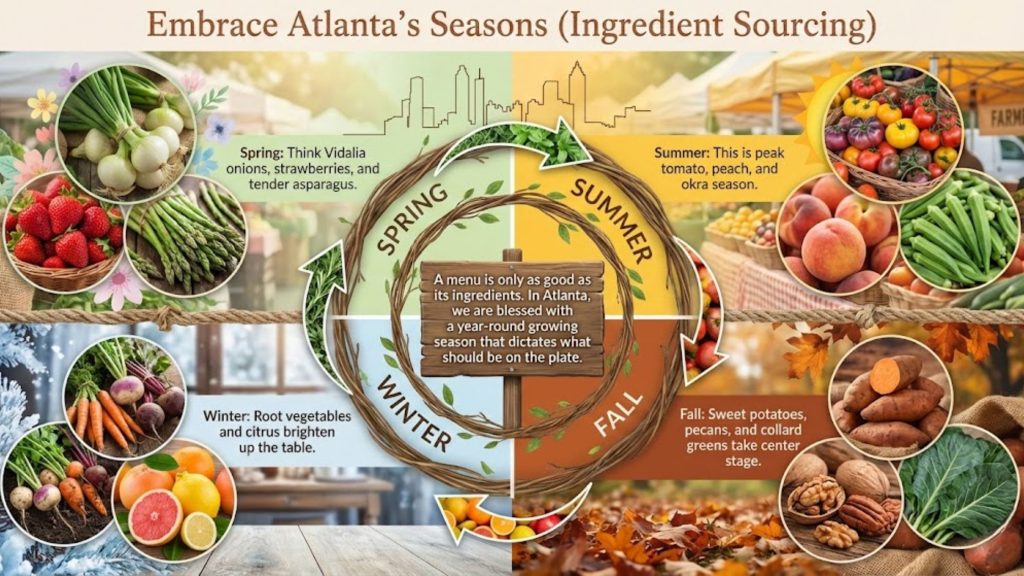
- Spring: Think Vidalia onions, strawberries, and tender asparagus.
- Summer: This is peak tomato, peach, and okra season.
- Fall: Sweet potatoes, pecans, and collard greens take center stage.
- Winter: Root vegetables and citrus brighten up the table.
When you shop at Morningside Farmers Market or Freedom Farmers Market, let the produce tell you what to make. If the strawberries aren’t fragrant, don’t force a strawberry tart. Pivot to a peach cobbler.
Chef’s Tip on Sourcing: If you are prioritizing health, look for local proteins. We source from Georgia ranchers who practice regenerative agriculture. High-quality ingredients don’t just taste better; they align better with the precise nutritional frameworks many of our clients follow.
3. Balance the Weight and Flow of the Meal
A perfect menu has a rhythm. You don’t want to serve a heavy cream soup followed by a rich risotto and a dense chocolate cake. Your guests will be asleep by 9:00 PM.
Think about the “weight” of the food.
- The Appetizer: Keep it light and acidic. A ceviche or a salad with bitter greens and a bright vinaigrette wakes up the palate.
- The Main: This is the anchor. If you are serving a rich cut of beef, pair it with something sharp, like chimichurri, rather than a heavy gravy.
- The Sides: This is where you can introduce volume without heaviness. Roasted vegetables seasoned with fresh herbs are always a winner.
- The Dessert: If the meal was heavy, go for fruit-based or a sorbet. If the meal was light (like fish), you can afford a richer dessert.
4. Precision Over Guesswork (The Health Factor)
This is the modern host’s secret weapon. If you have guests who are health-conscious or training for an event (perhaps the Peachtree Road Race), they will appreciate precision.
At a restaurant, portions are often massive and loaded with hidden sodium and fats to boost flavor. At home, you have control.
However, executing this level of precision can be difficult for the home cook. When our chefs design a menu for a client, we aren’t just “cooking.” We are often following strict guidelines provided by health professionals. We utilize weight-based metrics—measuring proteins in ounces and carbohydrates in grams—to ensure the meal supports the guests’ goals.
If you are debating whether to cook yourself, hire help, or just book a table at a restaurant, it’s worth weighing the pros and cons. As we detailed in our article on Personal Chef vs. Eating Out: The Pros and Cons, hosting at home allows for ingredient transparency that restaurants simply cannot match. You avoid the “seed oil” trap and the sodium bombs, ensuring your guests leave feeling energized, not sluggish.
5. Be Realistic About Logistics (Guest Count Matters)
Ambition is the enemy of the relaxed host. Attempting to plate a soufflé for 20 people in a standard residential kitchen is a recipe for disaster.
You must match your menu to your guest count and your kitchen’s capacity.
- For 4-8 Guests: You can do plated service. You can take risks with temperature-sensitive foods (like searing scallops).
- For 10-20 Guests: Family style is your best friend. Large platters of sliced flank steak, roasted vegetables, and grains allow guests to serve themselves.
- For 20+ Guests: You are entering “event” territory.
This is a common friction point. Many hosts assume that because they have a nice kitchen, they can handle a crowd of 30. But the logistics of keeping food hot and service flowing change drastically as the numbers rise.
If you are on the fence about whether you can handle the volume, it might be time to look at professional help. However, be careful not to confuse a personal chef with a catering company. They serve very different purposes. For a breakdown of which service suits your specific guest count and venue, read our guide on Personal Chef vs. Professional Catering. It will save you from hiring a wedding-style caterer for an intimate dinner, or conversely, asking a personal chef to feed an army without the necessary infrastructure.
6. The “Make-Ahead” Mandate
If you are cooking the meal yourself, 80% of the work should be done before the doorbell rings.
- Cold Appetizers: Have these plated in the fridge or set out at room temperature.
- The “Oven-Ready” Main: Braised short ribs are a host’s best friend because they actually taste better if made the day before and just reheated.
- Mise en Place: Chop every herb, peel every vegetable, and measure every sauce ingredient in the morning.
The goal is to be holding a cocktail, not a knife, when your friends arrive.
7. The Drink Pairing (Keep It Local)
Finally, tie the menu together with beverage pairings that honor our region. Atlanta’s craft beverage scene is booming.
- Beer: A crisp lager from a local ATL brewery beautifully with spicy foods or BBQ.
- Spirits: Try a whiskey from a local distillery for a smoked Old Fashioned to pair with red meat.
- Mocktails: Don’t forget the zero-proof crowd. Use fresh juices and herbs (like basil and peach) to create a drink that feels special without the alcohol.
The Ultimate Hosting Hack
Planning the perfect menu requires time, culinary knowledge, and logistical precision. It is rewarding, but it is also work.
If reading this list made you feel excited, then grab your apron and head to the market! But if it made you feel tired, remember that there is another way to host.
Atlanta Personal Chef Service allows you to be the guest at your own party.
- We collaborate with you (and your nutrition team) to design the perfect menu.
- We execute with weight-based precision and high-quality local ingredients.
- We clean up, leaving your kitchen spotless.
Whether you want a casual family-style spread or a multi-course tasting menu that strictly adheres to your dietary framework, we are here to make it unforgettable.